Notes on Proofs, Arguments, and Zero-Knowledge
ZKP
Tags: machine learning, security, privacy, and mobile computing.
Guided by Liyao Xiang.
Proofs, Arguments, and Zero-Knowledge
https://people.cs.georgetown.edu/jthaler/ProofsArgsAndZK.html
1 Introduction
- IPs: interactive proofs
- MIP: multi-prover interactive proofs
- PCP: probabilistically checkable proofs
- zk-SNARK: Zero-Knowledge Succinct Non-Interactive Argument of Knowledge
2 Fingerprinting and Freivalds’ Algorithm
2.1 Reed-Solomon Fingerprinting
A Reed-Solomon code can be viewed as a polynomial generated from the data (see Figure 2-1).
The probability of a hash collision must be small; otherwise, it undermines reliability.
2.2 Freivalds’ Algorithm
Both protocols reduce the task of checking whether two large objects are equal - vectors in Reed-Solomon fingerprinting, and the claimed and actual answer matrices in Freivalds’ algorithm - to checking the equality of one random entry in distance-amplifying encodings of those objects.
2.3 Lagrange Interpolation
Recurrence formula (2.10).
3 Definitions and Technical Preliminaries
3.1 IPs
Errors: $\delta_c$ is the completeness error, and $\delta_s$ is the soundness error.
Cost factors for an interactive proof:
- The running time of P and V
- The space used by P and V
- The total number of communicated bits
- The total number of messages exchanged
If V and P exchange $k$ messages, the upper bound $k/2$ is called the round complexity of the interactive proof system.
3.2 Argument Systems
- Computational soundness
- Reusability
- Public verifiability
3.3 Robustness
Why does Definition 3.1 require $\delta_c$ and $\delta_s$ to be at most 1/3?
This choice is for convenience or aesthetics and does not change the result.
3.4 Schwartz-Zippel Lemma
A degree-$d$ polynomial has at most $d$ roots.
3.5 Low-Degree and Multilinear Extensions
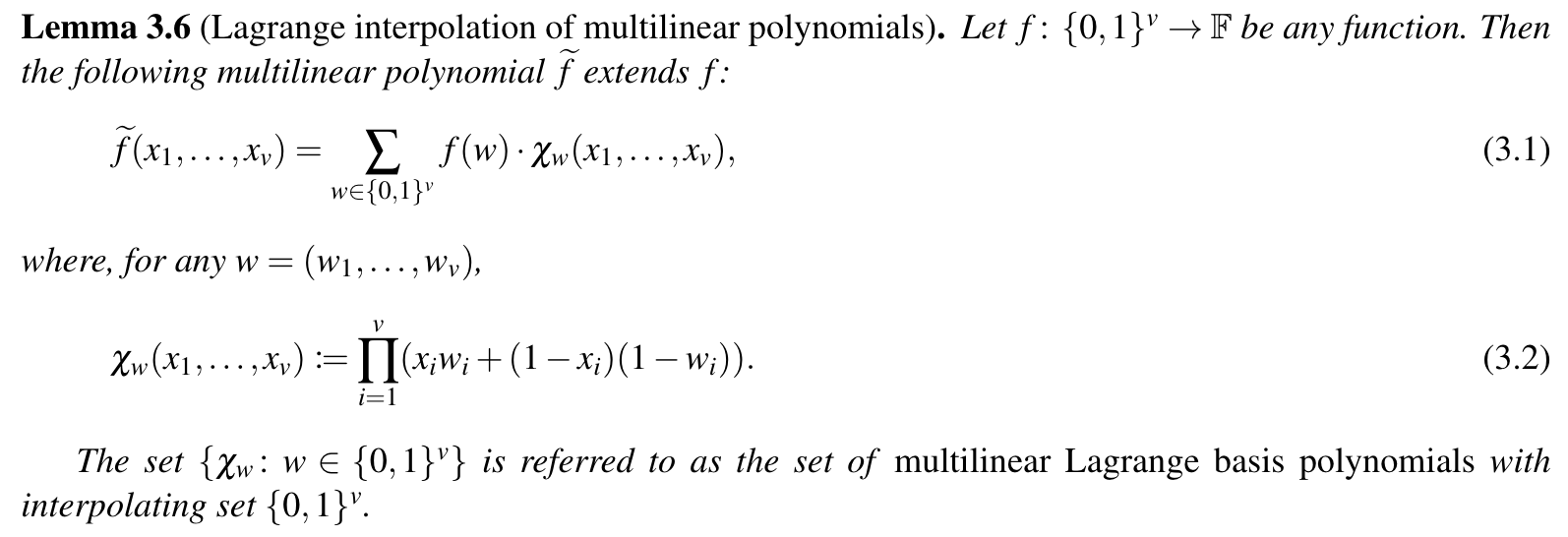
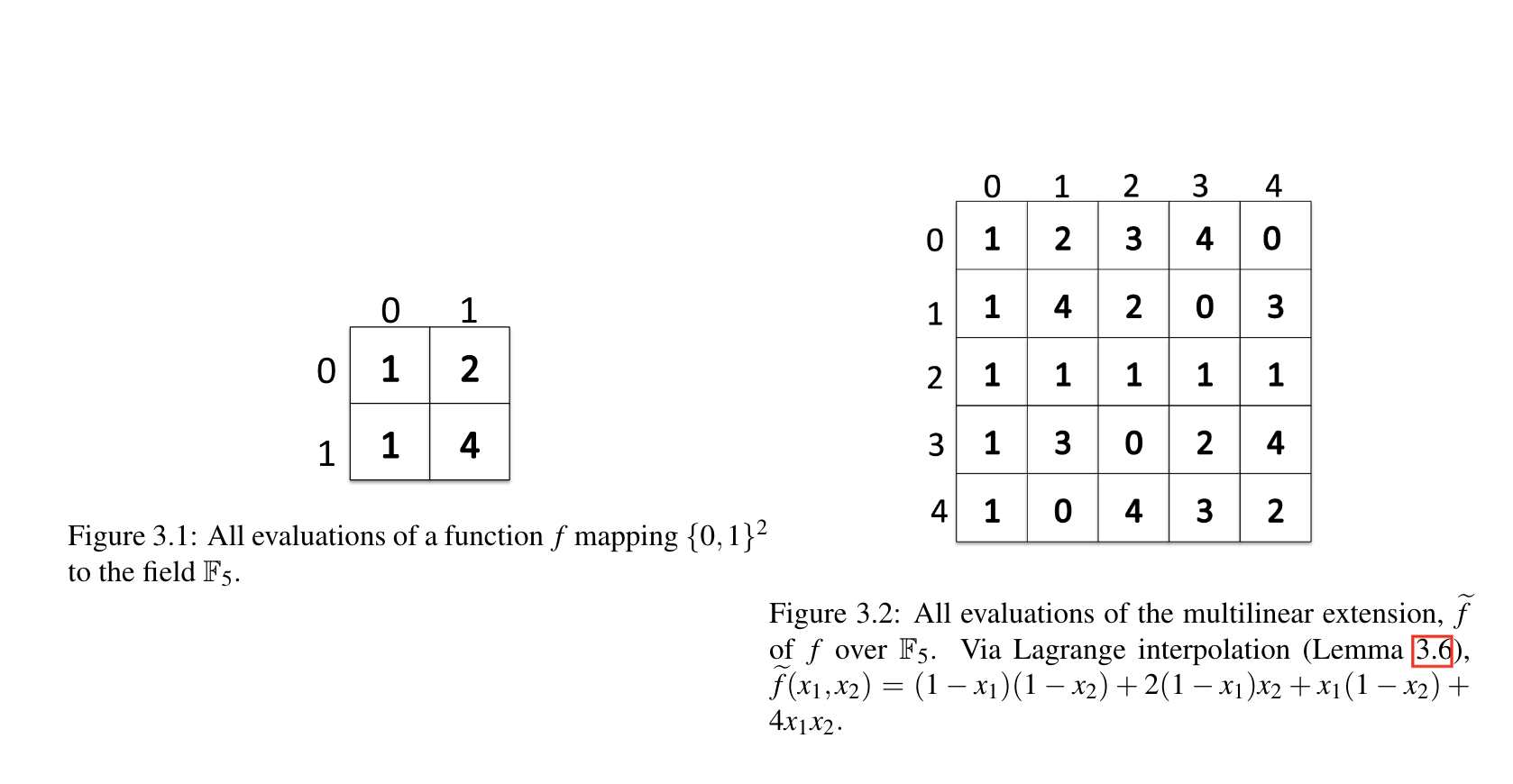
How is the Lagrange interpolation in Figure 3.2 used?
4 IPs
4.1 Sum-Check
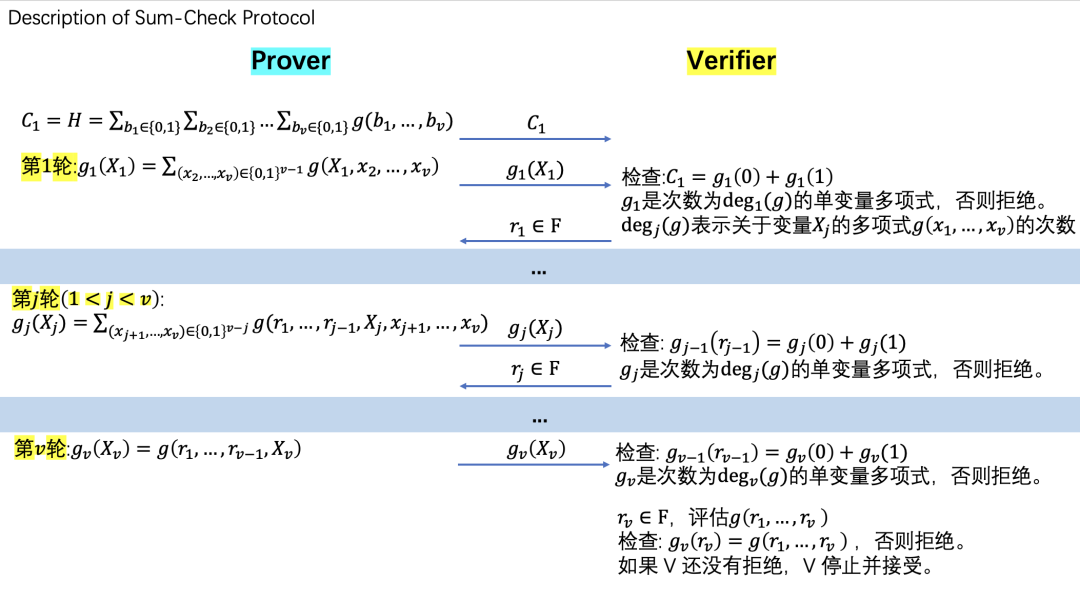
Example:
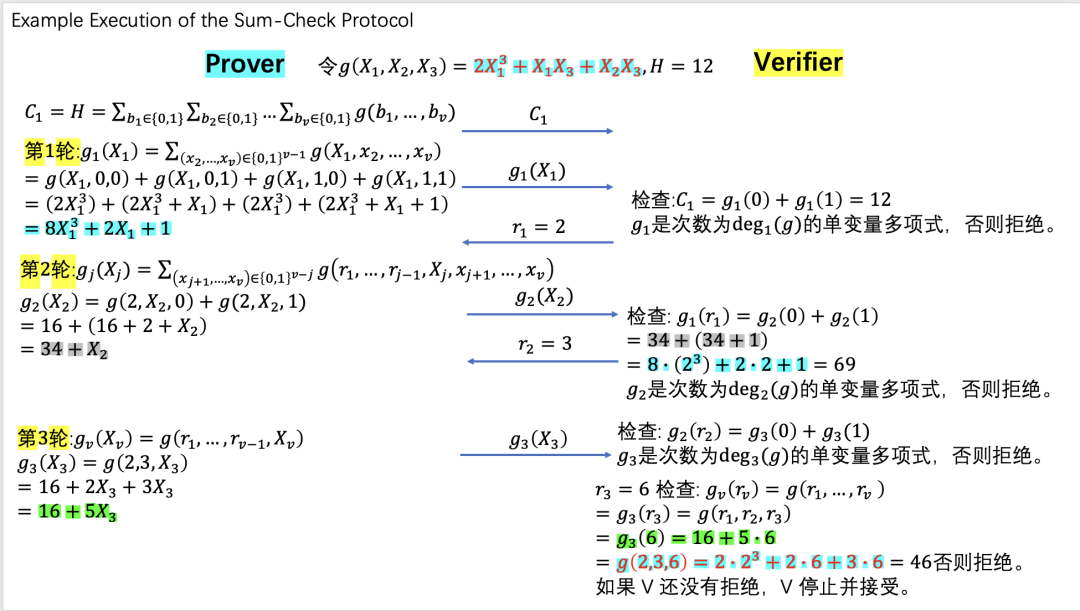
Advantage: the verifier’s messages to the prover contain only random field elements and are therefore completely independent of the input polynomial $g$.
4.2 SAT $\in$ IP
The SAT problem asks whether a formula in conjunctive normal form is satisfiable.
The SAT protocol is closely related to IP = PSPACE: the class of problems solvable by interactive proofs with polynomial-time verifiers is exactly the class of problems solvable in polynomial space.
Doubly efficient IPs.
4.4 Third Application: Super-Efficient IP for MATMULT
This section describes the highly optimized IP protocol for matrix multiplication (MATMULT) from [Tha13].
Given two $n \times n$ input matrices $A$ and $B$ over a field $F$, MATMULT computes the matrix product $C=A \cdot B$.
Compared with Freivalds’ protocol, this protocol avoids requiring P to send the complete answer matrix.
2.15
sec18-adi
Watermark MLaaS, where the service can only be used by one person.
Method: use backdoors.
(Pedersen commitment algorithm)
Opening a commitment: decrypting.
Two properties of commitments: binding and hiding.
Setup - input - proof - verify.
Peng: introduce the Pedersen commitment algorithm. For further reading, see Chapters 14-16 on polynomial commitments in Proofs, Arguments, and Zero-Knowledge.
Wu: read Chapter 10 of Proofs, Arguments, and Zero-Knowledge, focusing on Section 10.3.
Commitment
Use private data without decrypting it.
Process:
- Commit: for data $v$, compute the corresponding commitment $c$, then send $v$ and $c$ to the verifier.
- Open the commitment: receive $v$, compute the corresponding commitment $c’$, and compare $c$ with $c’$.
Two properties:
- Hiding: before the commitment is opened, the verifier does not know $v$.
- Binding: $v$ is uniquely associated with the commitment $c$.
The opening phase can use a ZKP to protect $v$.
Hash Commitment
The simplest commitment scheme.
For a hash function, one-wayness provides hiding, while collision resistance provides binding.
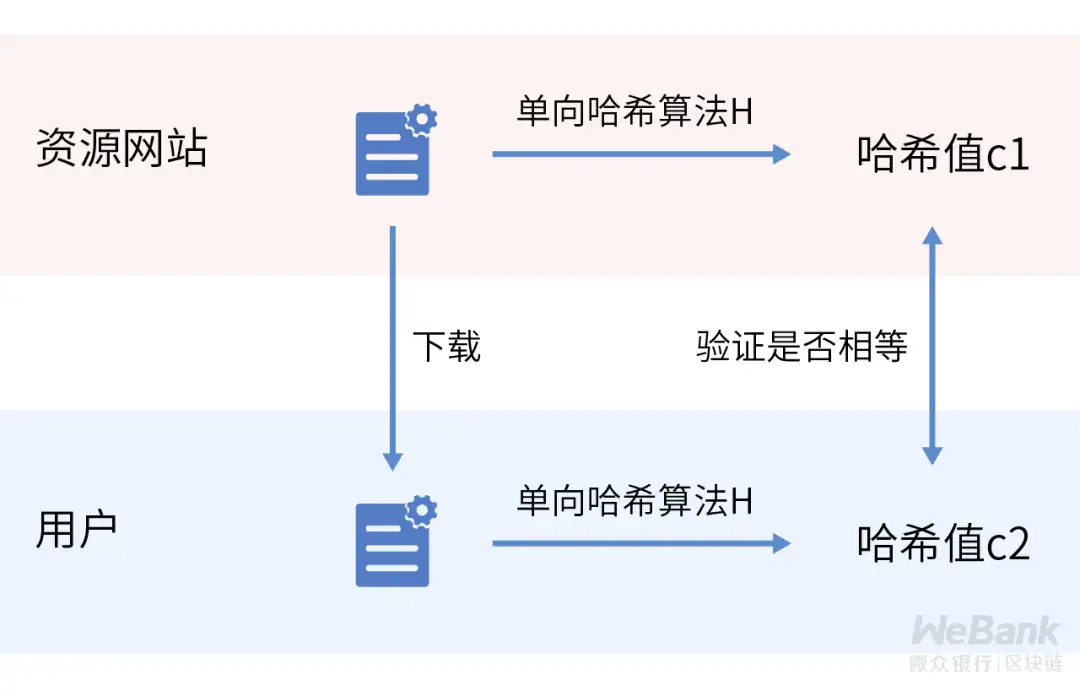
Image source: Cryptographic Commitments
Pedersen Commitment
Algorithm: Proofs, Arguments, and Zero-Knowledge, Section 12.3, Protocol 5.
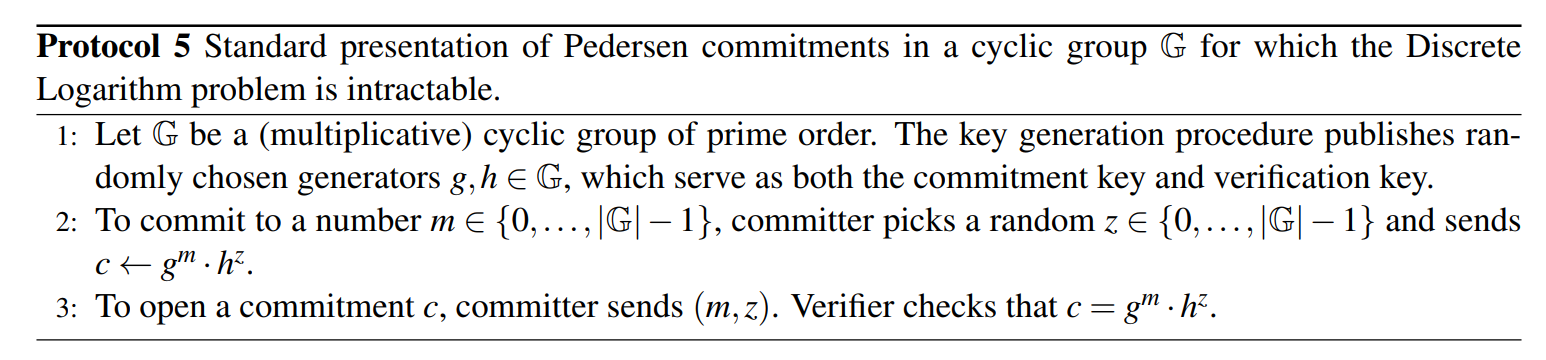
A cyclic group is a group $G$ in which every element is a power of one fixed element $a$. It is written as $G=(a)$, and $a$ is called a generator of the group. A group is a special kind of set, and “element” refers to a member of that set.
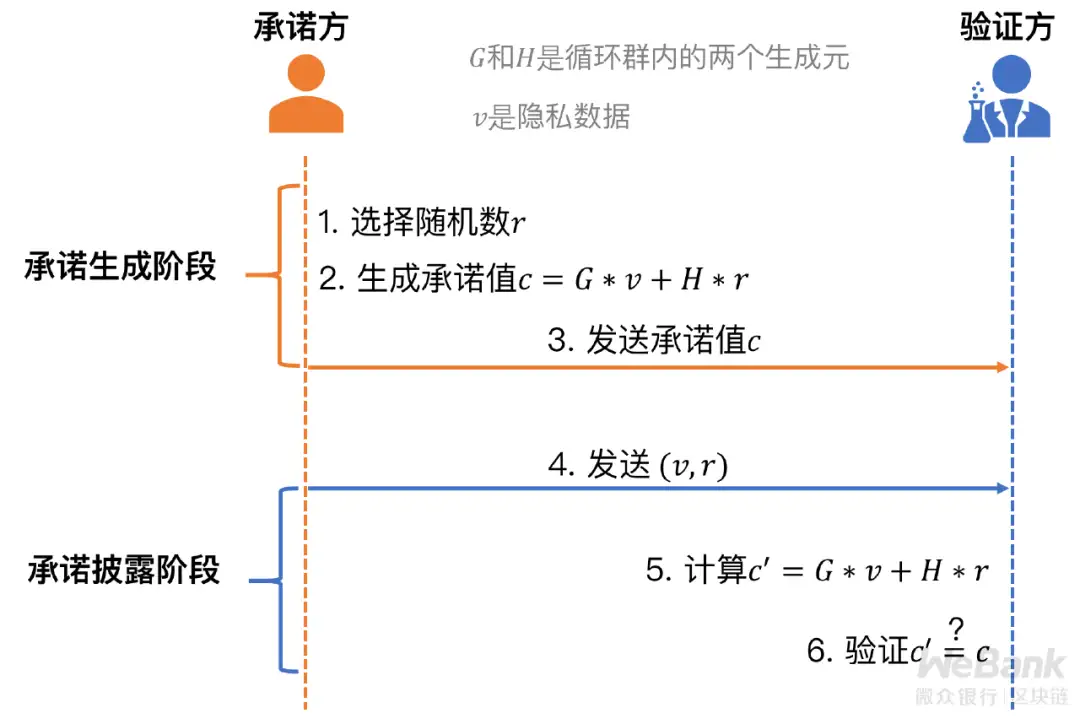
A random value plus the hardness of the discrete logarithm problem provides hiding.
$c=g^m h^z$ provides binding and additive homomorphism: two Pedersen commitments can be combined,
\[c_1 \cdot c_2 = g^{m_1} h^{z_1} \cdot g^{m_2} h^{z_2} = g^{m_1+m_2} h^{z_1+z_2} = g^{m_3} h^{z_3} = c_3.\]- Integer factorization problem
- Given two large primes $p$ and $q$, it is easy to compute $n=pq$. Given $n$, however, finding $p$ and $q$ is difficult.
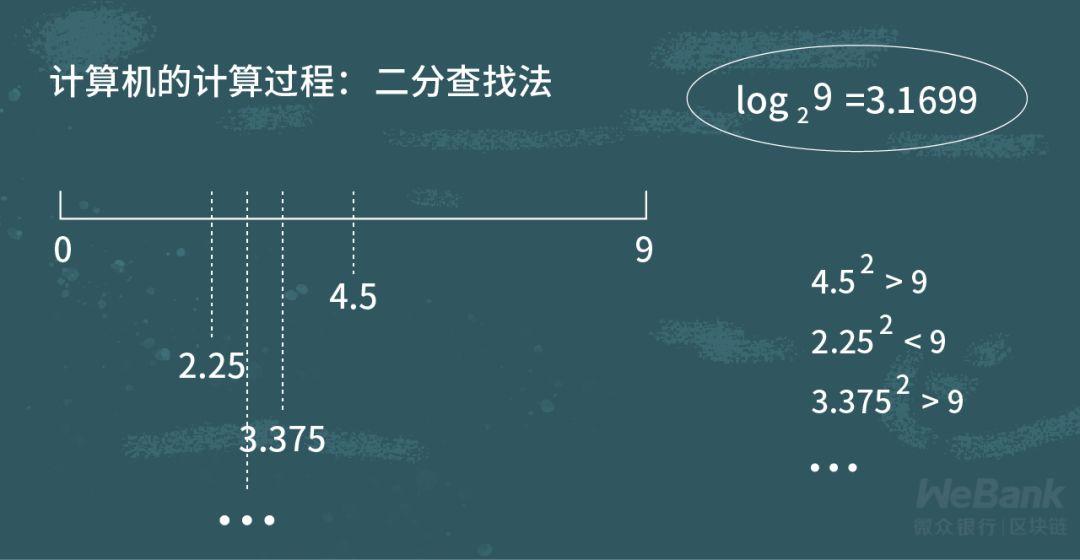
- Discrete logarithm problem
- Over the real numbers, computing $\log_2(9)$ using binary search is easy.
- In a finite field with modulus $n$ and generator $g$, given an integer $a$, it is easy to compute $g^a=b$. Given $b$ and $g$, however, computing $a$ is difficult. This involves arithmetic over finite fields.
- Over the real numbers, computing $\log_2(9)$ using binary search is easy.
- Elliptic-curve discrete logarithm problem
- In an elliptic-curve group over a finite field $F$, let $P$ be a point on the curve. Given an integer $a$, computing $aP=Q$ is easy. Given $P$ and $Q$, however, computing $a$ is difficult.
Polynomial Commitment
2.18
Watermarking, commitments, and ZKPs:
- Applications of digital watermarks in neural networks
- Combining digital watermarks with cryptographic tools such as zero-knowledge proofs
A Survey of Deep Neural Network Watermarking Techniques
A Systematic Review on Model Watermarking for Neural Networks
3.15
Blockchain timestamps and ambiguity attacks.
The model is public, but verification is black-box because the parameters are not disclosed.
Computational-resource assumption: an attacker will not spend excessive resources retraining a model because the cost would be too high.
The trigger must be strong enough that it cannot be removed through adversarial fine-tuning.
Translated from the original Chinese with AI assistance.